
You are using an out of date browser. It may not display this or other websites correctly.
You should upgrade or use an alternative browser.
You should upgrade or use an alternative browser.
Football The 2011/2012 Season Thread
- Thread starter megadave
- Start date

Wazzerphuk
FH is my second home
- Joined
- Dec 22, 2003
- Messages
- 12,054
Just a shame for us that Spurs didn't drop 3 points instead of 2, but this weekend's been pretty good to us.

Dislike immensely.Just a shame for us that Spurs didn't drop 3 points instead of 2, but this weekend's been pretty good to us.
 It's just a reversal of midweek fortunes.
FF has been a catastrophy for me, yet again.
Wazzerphuk
FH is my second home
- Joined
- Dec 22, 2003
- Messages
- 12,054
But I heard Swansea played well against you, Wolves didn't play well against us. 

Embattle
FH is my second home
- Joined
- Dec 22, 2003
- Messages
- 14,398
Wonder what the transfer window holds for us, because clearly the 14 available players per match have a collective IQ of a freshly curled turd.
Well on 5 Live they said it'll show whether AVB has real support or not, if they give him nothing it probably means they don't expect to keep him.

megadave
I am a FH squatter
- Joined
- Apr 3, 2006
- Messages
- 11,911
- Thread starter
- #8,679
He says he just wants a CB, which is worrying because our midfield is shit. Should have tried McEachran in the last two games, infact he should have started today. Guarantee he'll go on loan, look better than any of our midfielders then come back and be one of our best players, a season too late.

Keitanz
Can't get enough of FH
- Joined
- Nov 4, 2010
- Messages
- 2,760
"doesn't dive"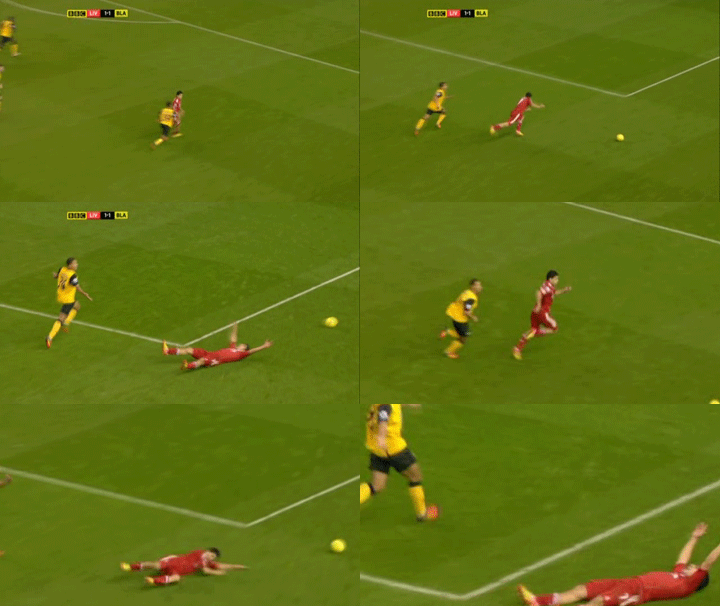
Lol.. imo even the stupidest player in world wouldn't have dived there.. unless the ref was completely blind.. did he get booked or something? must have done... I dunno.. but I really doubt that was a dive on purpose.. he really is not that retarded.
And nice results today, let's try keep this thread clean of the lollerpool and lolski and shit like that though

- Joined
- Dec 22, 2003
- Messages
- 39,302
no he won a freekick for that
Gets his heels clipped, at pace - you can see him kick himself because of that - and falls over ('cause of the foul), but does make a hewuge meal of it.
Even if you don't accept that - I could post a picture of a 90 year old who smokes 50 a day yet doesn't have cancer.
Funny how one point doesn't an argument make, eh?

Everz
FH is my second home
- Joined
- Nov 7, 2004
- Messages
- 13,685
But I heard Swansea played well against you, Wolves didn't play well against us.
zzzz.
We scored, you werent going to score (another) in a brother. With the ref up your arse and us down to ten-men.. how well do you expect us to play?
Wazzerphuk
FH is my second home
- Joined
- Dec 22, 2003
- Messages
- 12,054
zzzz.
We scored, you werent going to score (another) in a brother. With the ref up your arse and us down to ten-men.. how well do you expect us to play?

megadave
I am a FH squatter
- Joined
- Apr 3, 2006
- Messages
- 11,911
- Thread starter
- #8,686
Here's what Evra claimed
5. The FA's case, in short, was as follows. In the goalmouth, Mr Evra and Mr Suarez spoke to
each other in Spanish. Mr Evra asked Mr Suarez why he had kicked him, referring to the
foul five minutes previously. Mr Suarez replied "Porque tu eres negro", meaning "Because
you are black". Mr Evra then said to Mr Suarez “say it to me again, I’m going to punch
you”. Mr Suarez replied "No hablo con los negros", meaning "I don't speak to blacks". Mr
Evra continued by saying that he now thought he was going to punch Mr Suarez. Mr
Suarez replied "Dale, negro, negro, negro", which meant "okay, blackie, blackie, blackie".
As Mr Suarez said this, he reached out to touch Mr Evra's arm, gesturing at his skin. Mr
Kuyt then intervened. When the referee blew his whistle and called the players over to
him shortly after the exchanges in the goalmouth, Mr Evra said to the referee "ref, ref, he
just called me a fucking black".
and Suarez
6. Mr Suarez denied the Charge. His case, in short, was as follows. He agreed with Mr Evra
that they spoke to each other in Spanish in the goalmouth. When Mr Evra asked why he
had kicked him, Mr Suarez replied that it was a normal foul and shrugged his shoulders.
Mr Evra then said that he was going to kick Mr Suarez, to which Mr Suarez told him to
shut up. As Mr Kuyt was approaching, Mr Suarez touched Mr Evra's left arm in a
pinching style movement. According to Mr Suarez, at no point in the goalmouth did he
use the word "negro". When the referee blew his whistle to stop play, Mr Evra spoke to Mr
Suarez and said (in English) "Don't touch me, South American". Mr Suarez replied "Por
que, negro?". He says that he used the word “negro” in a way with which he was familiar
from his upbringing in Uruguay. In this sense, Mr Suarez claimed, it is used as a noun and
as a friendly form of address to people seen as black or brown-skinned (or even just blackhaired). Thus, it meant "Why, black?" Mr Suarez maintained that when he said "Por que,
negro?" to Mr Evra, it was intended in a conciliatory and friendly way. Mr Suarez said this 6
was the only time that he used the word “negro” in his exchanges with Mr Evra during
the match.
5. The FA's case, in short, was as follows. In the goalmouth, Mr Evra and Mr Suarez spoke to
each other in Spanish. Mr Evra asked Mr Suarez why he had kicked him, referring to the
foul five minutes previously. Mr Suarez replied "Porque tu eres negro", meaning "Because
you are black". Mr Evra then said to Mr Suarez “say it to me again, I’m going to punch
you”. Mr Suarez replied "No hablo con los negros", meaning "I don't speak to blacks". Mr
Evra continued by saying that he now thought he was going to punch Mr Suarez. Mr
Suarez replied "Dale, negro, negro, negro", which meant "okay, blackie, blackie, blackie".
As Mr Suarez said this, he reached out to touch Mr Evra's arm, gesturing at his skin. Mr
Kuyt then intervened. When the referee blew his whistle and called the players over to
him shortly after the exchanges in the goalmouth, Mr Evra said to the referee "ref, ref, he
just called me a fucking black".
and Suarez
6. Mr Suarez denied the Charge. His case, in short, was as follows. He agreed with Mr Evra
that they spoke to each other in Spanish in the goalmouth. When Mr Evra asked why he
had kicked him, Mr Suarez replied that it was a normal foul and shrugged his shoulders.
Mr Evra then said that he was going to kick Mr Suarez, to which Mr Suarez told him to
shut up. As Mr Kuyt was approaching, Mr Suarez touched Mr Evra's left arm in a
pinching style movement. According to Mr Suarez, at no point in the goalmouth did he
use the word "negro". When the referee blew his whistle to stop play, Mr Evra spoke to Mr
Suarez and said (in English) "Don't touch me, South American". Mr Suarez replied "Por
que, negro?". He says that he used the word “negro” in a way with which he was familiar
from his upbringing in Uruguay. In this sense, Mr Suarez claimed, it is used as a noun and
as a friendly form of address to people seen as black or brown-skinned (or even just blackhaired). Thus, it meant "Why, black?" Mr Suarez maintained that when he said "Por que,
negro?" to Mr Evra, it was intended in a conciliatory and friendly way. Mr Suarez said this 6
was the only time that he used the word “negro” in his exchanges with Mr Evra during
the match.
megadave
I am a FH squatter
- Joined
- Apr 3, 2006
- Messages
- 11,911
- Thread starter
- #8,687
Here's the summary from the judgement itself. The report is 115 pages so I'm sure each set of fans will find enough evidence to support their own opinions regardless.
IX Summary
452. The length of these Reasons reflects the complexity of this case, the detailed arguments that have been put before us, and the entitlement of those involved to know why we reached the decision that we did.
453. It may be helpful if we summarise our Reasons, which we do as follows:
(1) Whether a player has used abusive or insulting words or behaviour is a matter for us to decide as a Regulatory Commission, having regard to all the
circumstances of the case. These circumstances include the fact that many players playing in England come from overseas, with a different language and culture. However, we apply the standards that we consider appropriate to games played in England under the FA Rules. Whether the words or behaviour are abusive or insulting is an objective matter; it does not depend on whether the alleged offender intended his words to be abusive or insulting (paragraphs 50 to 73 above).
(2) The burden of proof in this case is on the FA. The standard of proof is the flexible civil standard of the balance of probability. The more serious the allegation, taking into account the nature of the misconduct alleged and the content of the case, the greater the burden of evidence required to prove the matter. The FA accepted that the allegation against Mr Suarez was serious, as do we (paragraphs 74 to 80 above).
(3) We received expert evidence as to the use of the word "negro" in Uruguay and other areas of Latin America. It is often used as a noun to address people, whether family, friends or passers-by, and is widely seen as inoffensive. However, its use can also be offensive. It depends on the context. It is inoffensive when its use implies a sense of rapport or the attempt to create such rapport. However, if it were used, for example, with a sneer, then it might carry negative connotations. The Spanish language experts told us that if Mr Suarez said the things that Mr Evra alleged, they would be considered racially offensive in Uruguay and other regions of Latin America (paragraphs 162 to 202 above).
(4) Mr Evra was a credible witness. He gave his evidence in a calm, composed and clear way. It was, for the most part, consistent, although both he and Mr Suarez were understandably unable to remember every detail of the exchanges between them (paragraphs 229 to 234 above).
(5) Mr Suarez's evidence was unreliable in relation to matters of critical importance. It was, in part, inconsistent with the contemporaneous evidence, especially the video footage. For example, Mr Suarez said that he pinched Mr Evra's skin in an attempt to defuse the situation. He also said that his use of the word "negro" to address Mr Evra was conciliatory and friendly. We rejected that evidence. To describe his own behaviour in that way was unsustainable and simply incredible given that the players were engaged in an acrimonious argument. That this was put forward by Mr Suarez was surprising and seriously undermined the reliability of his evidence on other matters (paragraphs 235 to 267 above). There were also inconsistencies between his accounts given at different times as to what happened (paragraphs 282 to 318).
(6) It was argued for Mr Suarez that Mr Evra invented the allegations to exact vengeance for Mr Suarez's refusal to apologise for the foul on Mr Evra; that he did so knowing that the allegations were false and that the complaint, if upheld, would be damaging to a fellow professional, who Mr Evra did not think was a racist. We rejected this argument as implausible and inconsistent with our assessment of Mr Evra as a witness. No alternative explanation was suggested to us as to why Mr Evra would make the allegations if untrue (paragraphs 323 to 337).
(7) Mr Suarez fouled Mr Evra in the 58th minute of the game. In the 63rd minute, Mr Evra challenged Mr Suarez about the foul. Mr Evra used an offensive phrase, which did not have any racial element and which Mr Suarez did not hear. An acrimonious argument ensued in which both players had a go at each other. In the course of this confrontation, Mr Suarez used the words "negro" or "negros" seven times. He did so both before and after the referee had spoken to them and told them to calm down. Mr Suarez addressed Mr Evra as "negro". He also made other derogatory comments using the word. In the course of the argument, Mr Suarez also pinched Mr Evra's skin (which was not in itself insulting behaviour nor did it refer to Mr Evra's colour) and put his hand on the back of his head, which were part of Mr Suarez's attempts to wind up Mr Evra (paragraphs 346 to 384 above).
(8) Mr Suarez's comments were made in the heat of the moment in response to being confronted by Mr Evra about the foul. He did not use the word "negro" in a way that could reasonably be translated as "nigger". He used the word “negro” because Mr Evra is black (paragraphs 383, 274 above).
(9) Mr Suarez's words, which included a reference to Mr Evra's colour, were insulting. The use of insulting words which include a reference to another person's colour on a football pitch are wholly unacceptable (paragraphs 385 to 399 above).
(10) Had Mr Suarez been sent off for using insulting words (not including reference to a person's colour), he would have received an automatic two-match suspension. The guidance in the FA Rules suggested that our starting-point should be to double that sanction, ie a four-match suspension. However, we were entitled to increase or reduce the penalty further. We took account of various aggravating and mitigating factors. As for the aggravating factors, Mr Suarez used the word "negro" or "negros" seven times, in the course of an acrimonious argument, and went beyond simply addressing Mr Evra as "negro". Mr Suarez knew or ought to have known that these words were unacceptable, particularly in view of the FA-supported campaigns against all forms of racism in football. The words were targeted directly at Mr Evra, as part of Mr Suarez's attempts to wind him up. As for the mitigating factors, Mr Suarez had a clean record in relations to charges of this type. Mr Evra started the confrontation in the goalmouth, in response to which Mr Suarez used the insulting words. Mr Suarez is likely to suffer personal embarrassment as a result of his behaviour coming to light through this decision. He has in the past supported, and continues to support, a charitable project in South Africa designed to promote multi-racial football. He is likely to have learned a lesson through the experience of these proceedings, and said that he would not use the word "negro" on a football pitch in England in the future (paragraphs 401 to 440 above).
(11) Balancing all these factors, we imposed an eight-match ban, a £40,000 fine and gave Mr Suarez a warning as to his future conduct. We considered this to be an appropriate and proportionate penalty in all the circumstances (paragraphs 441 to 446 above).

Turamber
FH is my second home
- Joined
- May 15, 2004
- Messages
- 3,559
Seems odd to me that a complaint is upheld despite Evra admitting to calling Suarez 'South American'. Is that not a racial attack, in the context of them sledging each other that is. Also how can a 115 page report be compiled when neither party can remember what happened? Should have told them both to grow up.
But no, it was an opportunity to take another pot shot at FIFA.
But no, it was an opportunity to take another pot shot at FIFA.
megadave
I am a FH squatter
- Joined
- Apr 3, 2006
- Messages
- 11,911
- Thread starter
- #8,689
Since when did "South American" have negative connotations though? If he'd called him a spic or something then I could see your point
Anyway from what I've read it sounds justified, mainly because of the evidence from Kuyt and Commoll that Suarez admitted saying "because you're black" in response to Evra's question.
Anyway from what I've read it sounds justified, mainly because of the evidence from Kuyt and Commoll that Suarez admitted saying "because you're black" in response to Evra's question.
Mr Comolli agreed that he believed he was told by Mr Suarez that the words that he had
used translated as "Why, because you are black". Of course, it is Mr Evra's case that Mr
Suarez did say to him "Porque tu eres negro" meaning "Because you are black". It is,
however, right to point out that Mr Evra contends that Mr Suarez said this to him in
response to his question "Why did you kick me", whereas Mr Suarez maintains that he
said "Por que, negro" in response to Mr Evra's comment "Don't touch me, South
American".
According to Mr Kuyt, Mr Suarez said to him that he had touched Mr Evra on the head
and he (Mr Evra) said something along the lines of "get away from me South American",
to which Mr Suarez replied "because you're black can't...why can't I touch you then". The
Dutch words which Mr Kuyt recalled Mr Suarez using were "omdat je zwart bent
mag...waarom mag ik je daarom niet aanraken". Mr Kuyt explained to us that the initial
phrase in this passage means "because you are black", i.e. omdat (because) je (you) zwart
(black) bent (are).
Mr Suarez dealt with this discrepancy in the following way in his witness statement:
"Dirk Kuyt also spoke to me after the match and I explained to him in Dutch what
had happened. His Dutch version of what was said appears to have lost something
in translation because he, too, is supposed to have heard from me that I said "Why
can't I touch you? Because you're black?" but all I said was "Por que negro?".
300.
When Mr Suarez said in this passage that Mr Kuyt "too" misheard Mr Suarez, that is a
reference to Mr Comolli also "mishearing" what Mr Suarez said.
The position, therefore, is as follows. Mr Suarez spoke in Spanish to Mr Comolli soon after
the game about this serious allegation. Mr Suarez also spoke in Dutch to Mr Kuyt. Both
Mr Comolli and Mr Kuyt understood Mr Suarez to have told them that when he spoke to
Mr Evra he said words which translate into English as, "Because you are black". According
to Mr Suarez, Mr Comolli misheard what Mr Suarez said in Spanish, and Mr Kuyt
misheard what Mr Suarez said in Dutch.
Mr Dalglish told the referee that Mr Suarez responded with "you are black" having first
been taunted with "you are South American". Mr Comolli is not recorded as using the
word "taunted", but said that Mr Evra said "you are South American" to Mr Suarez who
responded with "Tues negro" which translates "you are Black". There is no suggestion here
that Mr Evra had said "Don't touch me", yet this seems now to be an essential part of Mr
Suarez's evidence. We were not given any explanation as to why the referee was not told
that Mr Evra had said "Don't touch me, South American", as opposed to "you are South
American". Secondly, at least as expressly reported by Mr Dalglish, Mr Suarez's remark
was a riposte to being taunted by Mr Evra. If that is correct, it would suggest that Mr
Dalglish understood Mr Suarez's comment to be in the nature of retaliation for having
been called "South American". But that would suggest that the riposte "You are black" was
used in a derogatory sense, which is contrary to Mr Suarez's case. In fact, Mr Suarez told
us that he did not consider being described as South American to be derogatory, so it is
difficult to understand why this was referred to as a "taunt".
There were clearly a number of changes in Mr Suarez's account, both of the incident in the
goalmouth and the incident where Mr Suarez admitted to using the word “negro”
between his initial account as reported by Mr Dalglish and Mr Comolli, his interview on 2
November, his witness statement, and his case as presented at the hearing.
320. It is true to say that Mr Suarez had not seen all the video clips when he was interviewed,
and that it is not easy to piece together a detailed sequence of events which took place in a
brief period of time in a high-pressured match. On the other hand, a serious allegation had
been made against Mr Suarez. Mr Comolli took care after the match to find out what had
happened in view of the seriousness of the allegation. Mr Suarez had watched a recording
of the game with a view to preparing for his FA interview. It is a reasonable inference that
he had thought very carefully about what had happened at the key moments in the
penalty area, with the benefit of some recording to refresh his memory, in order to be able
to give a clear account in his interview and his witness statement.
321. The impression created by these inconsistencies was that Mr Suarez's evidence was not, on
the whole, reliable. He had put forward an interpretation of events which was inconsistent
with the contemporaneous video evidence. He had changed his account in a number of
important respects without satisfactory explanation. As a result, we were hesitant about
accepting Mr Suarez's account of events where it was disputed by other credible witnesses
unless there was solid evidence to support it.
megadave
I am a FH squatter
- Joined
- Apr 3, 2006
- Messages
- 11,911
- Thread starter
- #8,692
Strange conclusion imo Keitanz
So do you believe that when Suaez told Kuyt, Comolli and Daglish that he said "because you are black" that they all misinterpreted it?
The tests described above (except for credit in relation to unconnected matters) all had
some part to play in reaching our decision. This case is not simply about one person's
word against another. Whilst there were conflicting accounts of what happened which
were presented to us by Mr Evra and Mr Suarez, there was other relevant evidence which
we were able to take into account in reaching our decision. This other evidence included
video footage of the match; the evidence of others as to what happened during or immediately after the match; documentation in the form of the referee's report which was
based on conversations he had immediately after the match; transcripts of interviews with
the main protagonists and other witnesses conducted in the course of the FA's
investigation before witness statements were prepared for the purpose of this hearing; and
the evidence given to us by other witnesses quite apart from Mr Evra and Mr Suarez,
including expert witnesses on Spanish language. We reached our decision on the basis of a
consideration of the totality of the evidence attaching such weight as we considered
appropriate to the different elements of it.
So do you believe that when Suaez told Kuyt, Comolli and Daglish that he said "because you are black" that they all misinterpreted it?
Keitanz
Can't get enough of FH
- Joined
- Nov 4, 2010
- Messages
- 2,760
Really not going to bother shifting through all that.. wouldn't be surprised if most of it was made up as well to be honest..
I don't see where it says Suarez told Kuyt and the others that.. if that's really true then yeah.. I guess.
I don't see where it says Suarez told Kuyt and the others that.. if that's really true then yeah.. I guess.

Ch3tan
I aer teh win!!
- Joined
- Dec 22, 2003
- Messages
- 27,318
Really not going to bother shifting through all that.. wouldn't be surprised if most of it was made up as well to be honest..
I don't see where it says Suarez told Kuyt and the others that.. if that's really true then yeah.. I guess.
Head. In. Sand.
I've supported not over-reacting in this case, however this report is very damning.
If you can't even be bothered to read what megadave has posted (all of it), or even attempt the full report, then shut the fuck up?
It boils down to Suarez having an awful defence and not being backed up by his own team mate and manager; why he has not got his story straight with them is beyond belief.
If this were werewolf I would have gone vote Suarez
Ch3tan
I aer teh win!!
- Joined
- Dec 22, 2003
- Messages
- 27,318
"Mr Suarez's evidence was unreliable in relation to matters of critical importance," the report says, while adding that "Mr Evra was a credible witness".
Enough said. It was nothing but a campaign to back the 'Kick it Out' up.
At least read the summary or as much of the full report as possibly, don't be a Kietanz.
Keitanz
Can't get enough of FH
- Joined
- Nov 4, 2010
- Messages
- 2,760
Oh yeah have you read every page then? if you haven't then fuck off tooAt least read the summary or as much of the full report as possibly, don't be a Kietanz.
Ch3tan
I aer teh win!!
- Joined
- Dec 22, 2003
- Messages
- 27,318
You are a lollerpool bellend.Oh yeah have you read every page then? if you haven't then fuck off too

Corran
Part of the furniture
- Joined
- Dec 23, 2003
- Messages
- 6,180
haha, keitanz showing that the fans are as dumb as the players that wore teh suarez t-shirts after the ban.
I havent read the report yet, but i will do so. But seems that they have had lots of camera angles not broadcasted, lots of interviews etc and they think there is enough to uphold this. looks to me he shouuldnt appeal this and liverpool should stop burying their head in the sand
I havent read the report yet, but i will do so. But seems that they have had lots of camera angles not broadcasted, lots of interviews etc and they think there is enough to uphold this. looks to me he shouuldnt appeal this and liverpool should stop burying their head in the sand
Keitanz
Can't get enough of FH
- Joined
- Nov 4, 2010
- Messages
- 2,760
Oh yeah the players were totally wrong for showing support to their team mate....... they should have worn Kick it Out t-shirts with a picture of Suarez on the front.haha, keitanz showing that the fans are as dumb as the players that wore teh suarez t-shirts after the ban.
I havent read the report yet, but i will do so. But seems that they have had lots of camera angles not broadcasted, lots of interviews etc and they think there is enough to uphold this. looks to me he shouuldnt appeal this and liverpool should stop burying their head in the sand
Suarez did fuck up with what he said in the interviews etc really... and the club will appeal no matter what, even if they knew they are in the wrong.. they don't want that 8match ban..
Liverpool are just handling it just as every other club would have..
Users who are viewing this thread
Total: 2 (members: 0, guests: 2)