Exactly! The airspeed provided by the jet engines.xane said:It does not matter what the speed is relative to the ground, it matters what the speed is relative to the air.

You are using an out of date browser. It may not display this or other websites correctly.
You should upgrade or use an alternative browser.
You should upgrade or use an alternative browser.
Stupid physics question
- Thread starter Tom
- Start date

- Joined
- Dec 22, 2003
- Messages
- 5,755
xane said:A plane travelling 300 mph forward into a 300 mph headwind has a ground speed of 300 mph and an airspeed of 600 mph, it flies.
A plane travelling 300 mph forward with a 300 mph tailwind has a ground speed of 300 mph and an airspeed of 0 mph, it will crash (this is known as wind sheer and happens for real on takeoff and landing).
In the conveyor belt example there is no "wind" at all, no lift can be generated.
xane, just because the conveyor is moving at the same speed as the plane, does not prevent the imaginary plane moving forwards on the belt.
Assuming the wheels are amazing and dont fuck up and have no friction its like this:
I'm on roller skates on a treadmill, I'm holding on to a rope attached to the wall. I dont move.
When I pull on the rope(or in relation to the question, the engines pull the plane through the air) I move forwards, no matter how fast the belt is on because I'm disconnected from the belt due to the frictionless wheels. As I said in my previous post though, i very much doubt it could happen in the real world.

xane
Fledgling Freddie
- Joined
- Dec 22, 2003
- Messages
- 1,695
Tilda said:Thus the plane takes off in your imaginary world yes.
No it doesn't, the planes forward speed relative to the air is 0 mph, no lift is being generated.
In the real world, the conveyor belt would probably generate air speed as it drags the air directly above it, and that air speed may reach the wings and exceed the necessary speed required for lift.
Assuming the air speed is unaffected by the conveyor, no lift can generated and no takeoff happens.

Louster
One of Freddy's beloved
- Joined
- Dec 26, 2003
- Messages
- 882
... with our many massive conveyor belts adorning our highways and runways.Tilda said:In the real world
I have to say, I get the distinct impression you're trying to defend the gut reaction in your first two responses which you've realised isn't quite correct. The wheels 'not being able to endure the friction' is an absolutely irrelevant technicality - the fundamental point of the 'riddle' is that it's hard to envisage these things, as xane's analogy clearly shows, because we're so used to any sort of propulsion depending on the ground. Compare running on a treadmill with standing on a treadmill in rollerskates and pulling yourself along via the handrails, or something. (Edit - ah, see Tilda's above. Wrote before reading.)
The other part of the problem arises from the wording of the question, however. What exactly does it mean by "speed", anyhow? The misleading implication is that it keeps the plane still, which would indeed entail no lift-off, but that really wouldn't work. Observe - the idea behind it being kept still is that, if the conveyor belt is running, the plane will, at rest, move backwards at the same speed as the belt. This would be the case if the object was a car in gear, or if the plane had engaged its brakes - however, with free-spinning wheels, the plane's inertia will keep it mostly where it is. The friction between the wheels and the plane will mean it moves backwards, but nowhere near the same speed as the conveyor belt. I think from there it's pretty obvious.
- Joined
- Dec 22, 2003
- Messages
- 5,755
xane said:No it doesn't, the planes forward speed relative to the air is 0 mph, no lift is being generated.
In the real world, the conveyor belt would probably generate air speed as it drags the air directly above it, and that air speed may reach the wings and exceed the necessary speed required for lift.
Assuming the air speed is unaffected by the conveyor, no lift can generated and no takeoff happens.
Your missing my point, if as you suggest the belt kept the plane stationary then you're right, it wouldnt take off.
However, using the frictionless wheels, the belt can't keep the plane stationary, and the question dosn't suggest such a thing.
It says the belt moves at the same speed in the opposite direction. However, this force isn't transmitted to the plane because of the frictionless wheels, they just move faster.
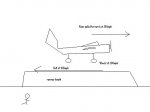
Look at my picture, the plane is being pulled forwards at 100mph, the belt is moving perhaps trying to counter it also at 100mph. However, the belt fails because it only increases the speed of the frictionless freewheeling wheels.
To the man on the ground, it looks like a normal takeoff, the plane is pulled forwards through the air by the engines, the same as in a normal takeoff, the only thing thats different is the speed of the wheels which are moving twice as fast.
Attachments
- Joined
- Dec 22, 2003
- Messages
- 5,755
It is, as I stated, acceptable to use the runway-belt because that is suggested in the question. However the question gives no hint that might lead us to conclude that the plane is anything out of the ordinary. Thus it is logical to assume that the plane is a normal plane, which I said, would not be able to take off. I standby this arguement, the tires would explode.
If I am to instantly say "ahh yes, the plane must have frictionless tires" what is to stop the question being totally misconstrued, perhaps in this imaginary world there is no gravity and the plane must simply turn off its suction pads to take off?!
Its nonsensicle to assume the plane is anything but normal until the question tells you otherwise, which it didnt.
If I am to instantly say "ahh yes, the plane must have frictionless tires" what is to stop the question being totally misconstrued, perhaps in this imaginary world there is no gravity and the plane must simply turn off its suction pads to take off?!
Its nonsensicle to assume the plane is anything but normal until the question tells you otherwise, which it didnt.
- Joined
- Dec 22, 2003
- Messages
- 5,755
Is, if i'm pulling myself along the treadmill, i have an airspeed the same as the rate i'm pulling myself forwards. Just as a plane, pulling itself along the treadmill with its engines has an airspeed of the speed its pulling itself through the air with its engines, the speed of the tires is irrelevant.xane said:The analogy with the roller skates and treadmill is not applicable, what matters is movement through air.
Louster
One of Freddy's beloved
- Joined
- Dec 26, 2003
- Messages
- 882
Except it's completely beside the point of the question, and you did indeed say:
Remember?Tilda said:Your right, except the plane isn't moving forwards as the conveyorbelt keeps up with it, so it cant move forwards, so it cant take off.
- Joined
- Dec 22, 2003
- Messages
- 5,755
Louster said:Except it's completely beside the point of the question, and you did indeed say:
Remember?
Read what I wrote. I (wrongly) assumed that the plane wasn't moving. However the conclusion I drew, that if the plane wasnt moving on the conveyor belt, it couldnt take off, is still correct. Its just that due to its incredible frictionless wheels it can move forwards.
xane
Fledgling Freddie
- Joined
- Dec 22, 2003
- Messages
- 1,695
I understand Tilda's point.
If the question was phrased to give the impression that the plane stays still relative to a person standing off the conveyor belt, then the answer is that the plane would not take off as no air movement is across the wing surface.
However, based on the physics demonstrated by Tilda, the question is seemingly flawed, as the plane would only stay still if the wheels were directly driven and forward movement was reliant upon friction with the belt surface, any external propulsion would still enable the plane to move along the conveyor belt.
As planes traditionally don't get propulsion from their wheels, then the plane would move forward. However, the propulsion system is not specified.
So we either have:
(a) it's a clever deliberate trick question meant to fool us into thinking the plane will stay still by leaving out the method of propulsion, very subtle as it involves two strains of thinking about physics.
(b) it's a load of bollocks because it attempts to demonstrate a situation of a standing still plane but fails because the physics of friction are not understood.
I went for (b).
If the question was phrased to give the impression that the plane stays still relative to a person standing off the conveyor belt, then the answer is that the plane would not take off as no air movement is across the wing surface.
However, based on the physics demonstrated by Tilda, the question is seemingly flawed, as the plane would only stay still if the wheels were directly driven and forward movement was reliant upon friction with the belt surface, any external propulsion would still enable the plane to move along the conveyor belt.
As planes traditionally don't get propulsion from their wheels, then the plane would move forward. However, the propulsion system is not specified.
So we either have:
(a) it's a clever deliberate trick question meant to fool us into thinking the plane will stay still by leaving out the method of propulsion, very subtle as it involves two strains of thinking about physics.
(b) it's a load of bollocks because it attempts to demonstrate a situation of a standing still plane but fails because the physics of friction are not understood.
I went for (b).
Louster
One of Freddy's beloved
- Joined
- Dec 26, 2003
- Messages
- 882
And read what I wrote - the wheels are beside the point. Yes, the confusion over the question is apparently created by the implication that the plane 'isn't moving', but even assuming that the wheels aren't perfectly frictionless, it won't have a whole lot of effect on the general physics of the thing.
And on a side note, it looks like takeoff speeds can get rather high, anyway. So I'm not so sure that the undercarriage wheels are going to be especially fragile.
And on a side note, it looks like takeoff speeds can get rather high, anyway. So I'm not so sure that the undercarriage wheels are going to be especially fragile.
xane
Fledgling Freddie
- Joined
- Dec 22, 2003
- Messages
- 1,695
Tilda said:Is, if i'm pulling myself along the treadmill, i have an airspeed the same as the rate i'm pulling myself forwards.
Assuming you are on a treadmill that is running, your airspeed is your forward speed minus the speed of the belt, i.e. your movement relative to the air.
Run at 15 mph forward on a treadmill that is set at 15 mph, you stay where you are and you don't have a 15 mph wind on your face.
- Joined
- Dec 22, 2003
- Messages
- 5,755
xane said:Assuming you are on a treadmill that is running, your airspeed is your forward speed minus the speed of the belt, i.e. your movement relative to the air.
Run at 15 mph forward on a treadmill that is set at 15 mph, you stay where you are and you don't have a 15 mph wind on your face.
That is exactly what I said!
For the pulling:
Treadmill - 15mph
My pull speed - 2mph
Rollerskates wheel speed - 17mph
My air speed - 2mph
Conclusion, I move forwards along the treadmill at 2mph.
For the plane:
Treadmill - 100mph
Engine pull speed(because they pull the plane through the air, they dont push forwards against the ground) - 100mph
Plane wheel speed -200mph
Plane air speed -100mph
Conclusion the plane takes off.
For running:
Treadmill speed - 15mph
Leg speed - 15mph
Air speed - 0mph.
Because unlike the two above examples, here, my propulsion depends on the contact between my "wheels" and the treadmill, they are both linked. Whereas in the rollerskates and plane examples, the speed, or even motion at all, of the treadmill has no effect on the airspeed of the plane/person.

ECA
I am a FH squatter
- Joined
- Dec 23, 2003
- Messages
- 9,466
If the implied statement that the plane is stationary at a certain point, then unless its got VTOL it cannot take off because there is no lift being given to the wings.
Ie its badly worded gash that you can make an argument for both ways.
Ie its badly worded gash that you can make an argument for both ways.

Tom
I am a FH squatter
- Joined
- Dec 22, 2003
- Messages
- 17,685
- Thread starter
- #46
At first I thought the plane wouldn't move.
But actually, it will.
Imagine those airport conveyor belts for passengers, that guide you through the terminal. Imagine you put your luggage on one of them, and walk alongside dragging your luggage the wrong way.
If the belt was moving at 4mph, and you're walking about 4mph, the luggage comes with you at 4mph - 8mph relative to the belt. If you started walking at 8mph, then your luggage will be moving at 8mph, 12mph relative to the belt.
So the plane, being pushed along by its engines, will move. The wheels will get a bit hot, but some planes don't need much speed to take off.
Therefore, plane goes flying
But actually, it will.
Imagine those airport conveyor belts for passengers, that guide you through the terminal. Imagine you put your luggage on one of them, and walk alongside dragging your luggage the wrong way.
If the belt was moving at 4mph, and you're walking about 4mph, the luggage comes with you at 4mph - 8mph relative to the belt. If you started walking at 8mph, then your luggage will be moving at 8mph, 12mph relative to the belt.
So the plane, being pushed along by its engines, will move. The wheels will get a bit hot, but some planes don't need much speed to take off.
Therefore, plane goes flying
ECA
I am a FH squatter
- Joined
- Dec 23, 2003
- Messages
- 9,466
Tom said:At first I thought the plane wouldn't move.
But actually, it will.
Imagine those airport conveyor belts for passengers, that guide you through the terminal. Imagine you put your luggage on one of them, and walk alongside dragging your luggage the wrong way.
If the belt was moving at 4mph, and you're walking about 4mph, the luggage comes with you at 4mph - 8mph relative to the belt. If you started walking at 8mph, then your luggage will be moving at 8mph, 12mph relative to the belt.
So the plane, being pushed along by its engines, will move. The wheels will get a bit hot, but some planes don't need much speed to take off.
Therefore, plane goes flying
Thats such horrible maths I want to shoot myself in the face.
Louster
One of Freddy's beloved
- Joined
- Dec 26, 2003
- Messages
- 882
Nah, the "implied statement" may be meant to make you think that it's stationary, but there's no way that would actually happen unless its propulsion was derived from its wheels - which is exactly why it produces confusion and debate. So maybe its 'bad wording' is, you know, intentional?ECA said:If the implied statement that the plane is stationary at a certain point, then unless its got VTOL it cannot take off because there is no lift being given to the wings.
Ie its badly worded gash that you can make an argument for both ways.

Aithe
Fledgling Freddie
- Joined
- Apr 30, 2004
- Messages
- 374
Tilda said:Plane engines - 100mph
Belt speed - 100mph
Amazing tire speed - 200mph
You can compare the convoyer belt to a very long runway. the effect of the belt is that the plane does not move. the tire speed will still be the normal 100 mph. Because the belt holds the plane in place there is no movement -> no lift -> no take off
Louster said:Nah, the "implied statement" may be meant to make you think that it's stationary, but there's no way that would actually happen unless its propulsion was derived from its wheels - which is exactly why it produces confusion and debate. So maybe its 'bad wording' is, you know, intentional?
Why would the propulsion not being derived from the weels stop it from moving forward? the weels do need to move for the whole plane to move, since the plane rests on them due to gravity.
Louster
One of Freddy's beloved
- Joined
- Dec 26, 2003
- Messages
- 882
We've already been over this. Imagine two very, very heavy objects. One of them has free-wheeling wheels, the other does not. Now place both of them on stationary conveyor belts. Run the conveyor belt. What do you think will happen?
The answer is this (and I think it's reasonably easy to verify, if you don't believe me). The one without wheels (assuming it has a non-slippery surface) will move at the same rate as the conveyor belt, as it is in complete and direct contact with it. The one with wheels, while still moving in the same direction as the belt, will be moving at a much lesser speed. The larger the mass of the object, and the smaller the friction between its axles and the wheels, the less movement it will exhibit. This is inertia.
Now, considering that this happens without any force being exerted on the object, you can see that applying a force (that is entirely independent of the ground) on the object with wheels will have almost the same effect as if the belt was stationary.
The answer is this (and I think it's reasonably easy to verify, if you don't believe me). The one without wheels (assuming it has a non-slippery surface) will move at the same rate as the conveyor belt, as it is in complete and direct contact with it. The one with wheels, while still moving in the same direction as the belt, will be moving at a much lesser speed. The larger the mass of the object, and the smaller the friction between its axles and the wheels, the less movement it will exhibit. This is inertia.
Now, considering that this happens without any force being exerted on the object, you can see that applying a force (that is entirely independent of the ground) on the object with wheels will have almost the same effect as if the belt was stationary.
- Joined
- Dec 22, 2003
- Messages
- 5,755
If this were the case, and the plane was held in place you would be correct. however, you assume, wrongly that the belt is keeping the plane still, however, the question says no such thing. Thus, the plane can move forwards along the belt as I said, its just the belt will speed up in the opposite direction and its tires will spin faster.Aithe said:You can compare the convoyer belt to a very long runway. the effect of the belt is that the plane does not move. the tire speed will still be the normal 100 mph. Because the belt holds the plane in place there is no movement -> no lift -> no take off.
Aithe said:Why would the propulsion not being derived from the weels stop it from moving forward? the weels do need to move for the whole plane to move, since the plane rests on them due to gravity.
If propulsion were derived from the wheels, the fact the belt was going the other way, would mean, any attempt to move forwards would be countered by movement of the belt.
However with planes the wheels just rest, they dont *have* to turn to move the plane forwards. The fact is, because the wheels dont have to turn to move it forwards, any force put upon the wheels, stops there, it dosn't get passed on to the plane body. Thus the belt and the wheels can be looked at distinctly from the engines and the plane. It dosnt matter how fast the wheels go, as long as they have no friction, the engines pulling the plane forwards won't be effected by the movement of the belt in the opposite direction.
If a plane flys low (with its wheels up) over a conveyor belt, does it stop? no.
Similarly, if a plane flys low over a belt, with its wheels down, and goes just low enough to touch them down, does the plane stop? No, the wheels go really fast, but the plane stays in the sky.


dysfunction
FH is my second home
- Joined
- Dec 22, 2003
- Messages
- 9,709
This works exactly the same as running on a treadmill...you run at exactly the same speed as the treadmill and you have no wind blowing in your face.
You remain stationary in relations to everything around you....but work very hard....
The plane would therefore not lift off the ground as there is no air moving past it.
You remain stationary in relations to everything around you....but work very hard....
The plane would therefore not lift off the ground as there is no air moving past it.

DaGaffer
Down With That Sorta Thing
- Joined
- Dec 22, 2003
- Messages
- 18,977
The plane doesn't move. The key phrase is in the question:
There is no mention of wheel-generated or thrust-generated speed, just speed. So this hypothetical conveyer is making the plane stand still as long as the plane is in contact with it (the wheel rotation is a red herring - this isn't a real world exercise). Therefore the plane isn't moving into the wind, there's no pressure change under the wing and no takeoff.
This conveyer has a control system that tracks the plane speed and tunes the speed of the conveyer to be exactly the same
There is no mention of wheel-generated or thrust-generated speed, just speed. So this hypothetical conveyer is making the plane stand still as long as the plane is in contact with it (the wheel rotation is a red herring - this isn't a real world exercise). Therefore the plane isn't moving into the wind, there's no pressure change under the wing and no takeoff.
xane
Fledgling Freddie
- Joined
- Dec 22, 2003
- Messages
- 1,695
DaGaffer said:So this hypothetical conveyer is making the plane stand still as long as the plane is in contact with it (the wheel rotation is a red herring - this isn't a real world exercise). Therefore the plane isn't moving into the wind, there's no pressure change under the wing and no takeoff.
Well, as Tilda demonstrates, a conveyor belt would only work if the propulsion system directly involved the wheels, i.e. it relied on frictional contact with the ground, like a regular car.
However, most planes don't have this form of propulsion, in a frictionless environment the external propulsion (propeller or jet) would still move the plane along the conveyor, the wheels would just move faster.
Hypothetical conveyor or not, it is a meaningless and useless device for controlling the relative speed of the plane, so the question is either a trick one, or it is flawed by lack of knowledge on how friction physics works.
It's like the "Cowboy rides into town on Friday, stays three days, and leaves on Friday" sort of question, it is just plain bollocks.

Chilly
Balls of steel
- Joined
- Dec 22, 2003
- Messages
- 9,047
bloody ell.
if air speed = 0
takeoff = false!
On the other hand, I dont believe the air speed *will* be zero. There is no flakey maths coming, dont worry.
The engines will pull a bit of air thru them, causing a slight air speed (maybe a few mph). But the conveyor belt is going to be made of some real material which will have friction. Now, this conveyor will get the air above it moving in its direction, so:
plane +100mph
belt -100mph
air -fairly quick id imagine
so if its a light plane that can take off at, say, 80mph - there is a chance this may occur.
This all depends on the speed the conveyor moves though and how quickly it drags air along with it.
All the arguments about crazy non-euclidian maths that doesnt add up even in your own special universe are bollocks.
if air speed = 0
takeoff = false!
On the other hand, I dont believe the air speed *will* be zero. There is no flakey maths coming, dont worry.
The engines will pull a bit of air thru them, causing a slight air speed (maybe a few mph). But the conveyor belt is going to be made of some real material which will have friction. Now, this conveyor will get the air above it moving in its direction, so:
plane +100mph
belt -100mph
air -fairly quick id imagine
so if its a light plane that can take off at, say, 80mph - there is a chance this may occur.
This all depends on the speed the conveyor moves though and how quickly it drags air along with it.
All the arguments about crazy non-euclidian maths that doesnt add up even in your own special universe are bollocks.
Well it's a good job that on airplanes they do then!Aithe said:ah yes, you are right, but only if the weels spin free
This analogy would be correct if not for the fact that it is completely wrong. Either you haven't read the multitude of replies explaining it, or you haven't understood them.dysfunction said:This works exactly the same as running on a treadmill...you run at exactly the same speed as the treadmill and you have no wind blowing in your face.
You remain stationary in relations to everything around you....but work very hard....
The plane would therefore not lift off the ground as there is no air moving past it.
The speed the wheels spin has no bearing on the speed of the airplane as a whole, and although the wheels spin twice as fast it still takes off fine. This should be the end of the discussion.
That said, this question has done a very good job around the internet of showing how people can't cope with moderately simple systems outside of their immediate experience, and trust their knee-jerk answers more than logic.
Sweet jesus I hope this was sarcasm.Chilly said:There is no flakey maths coming, dont worry.
dysfunction
FH is my second home
- Joined
- Dec 22, 2003
- Messages
- 9,709
Xgkkp said:Well it's a good job that on airplanes they do then!
This analogy would be correct if not for the fact that it is completely wrong. Either you haven't read the multitude of replies explaining it, or you haven't understood them.
The speed the wheels spin has no bearing on the speed of the airplane as a whole, and although the wheels spin twice as fast it still takes off fine. This should be the end of the discussion.
That said, this question has done a very good job around the internet of showing how people can't cope with moderately simple systems outside of their immediate experience, and trust their knee-jerk answers more than logic.
I dont think you you have comprehended the facts....
Users who are viewing this thread
Total: 2 (members: 0, guests: 2)